Rain ponchos are a low-drama purchase right up until they are not. Get the order right and they are the cheapest goodwill a venue ever buys, keeping a crowd dry and putting a logo on every phone camera in the stands. Get it wrong and you find out at the worst possible moment, with a line at the merch table and a sky that will not quit. The failures are predictable, and every one of them is avoidable at the ordering stage. Here are the mistakes that actually cost event teams money, and how to design them out before you place the order.
Under-ordering because you planned for drizzle
The single most expensive mistake is buying for the weather you hope for instead of the weather that empties your table. When it sprinkles, a modest share of a crowd bothers with a poncho. When it genuinely pours and there is no cover, that share climbs steeply, and the two scenarios call for very different quantities.
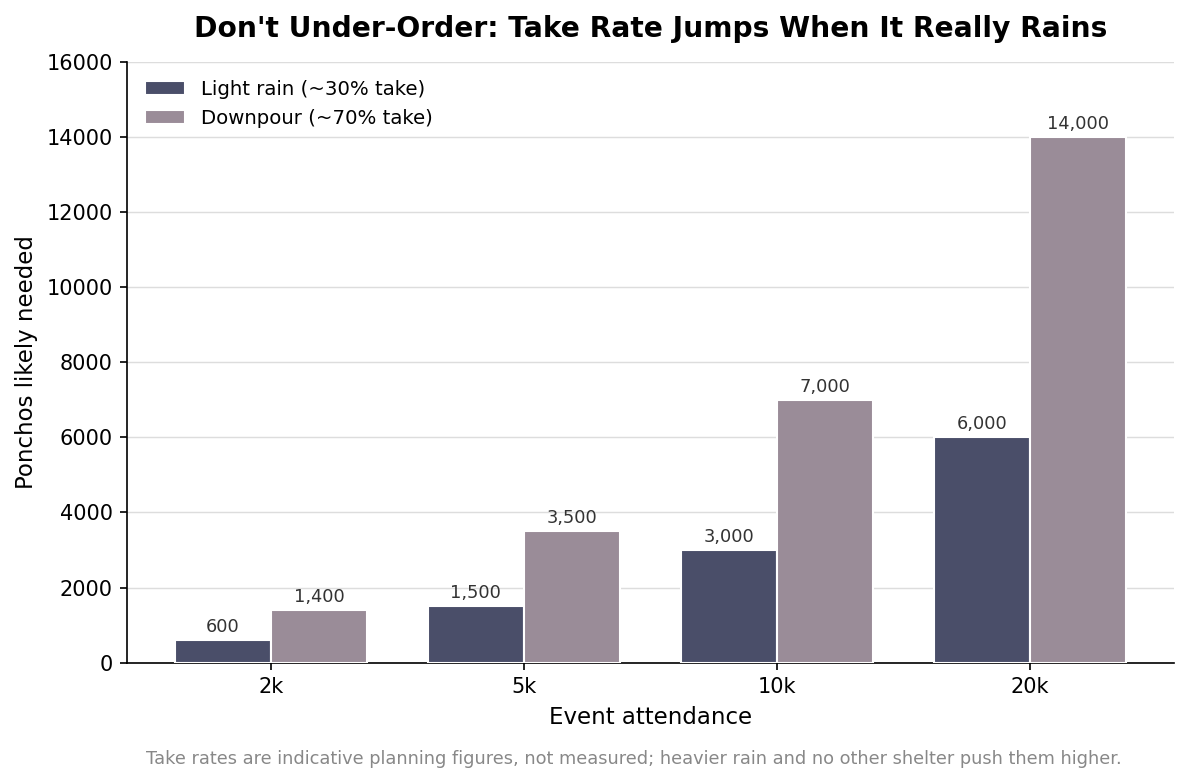
The take rates in the chart are planning figures rather than measured facts, but the shape is the lesson: the gap between a light-rain and a heavy-rain crowd is enormous at scale, and stadiums and festivals sit at the right end of that axis. Because unbranded or lightly branded ponchos store flat and keep for years, the cost of over-ordering is a box in a closet, while the cost of under-ordering is a soaked, unhappy crowd and a sponsor whose logo never made it onto anyone’s back. Buy toward the downpour case, not the drizzle case.
Ordering too late to matter
The second costly error is treating lead time as a formality. A branded, custom-run poncho manufactured overseas has a very different clock than a stock poncho with a quick imprint, and confusing the two is how orders miss the event entirely.
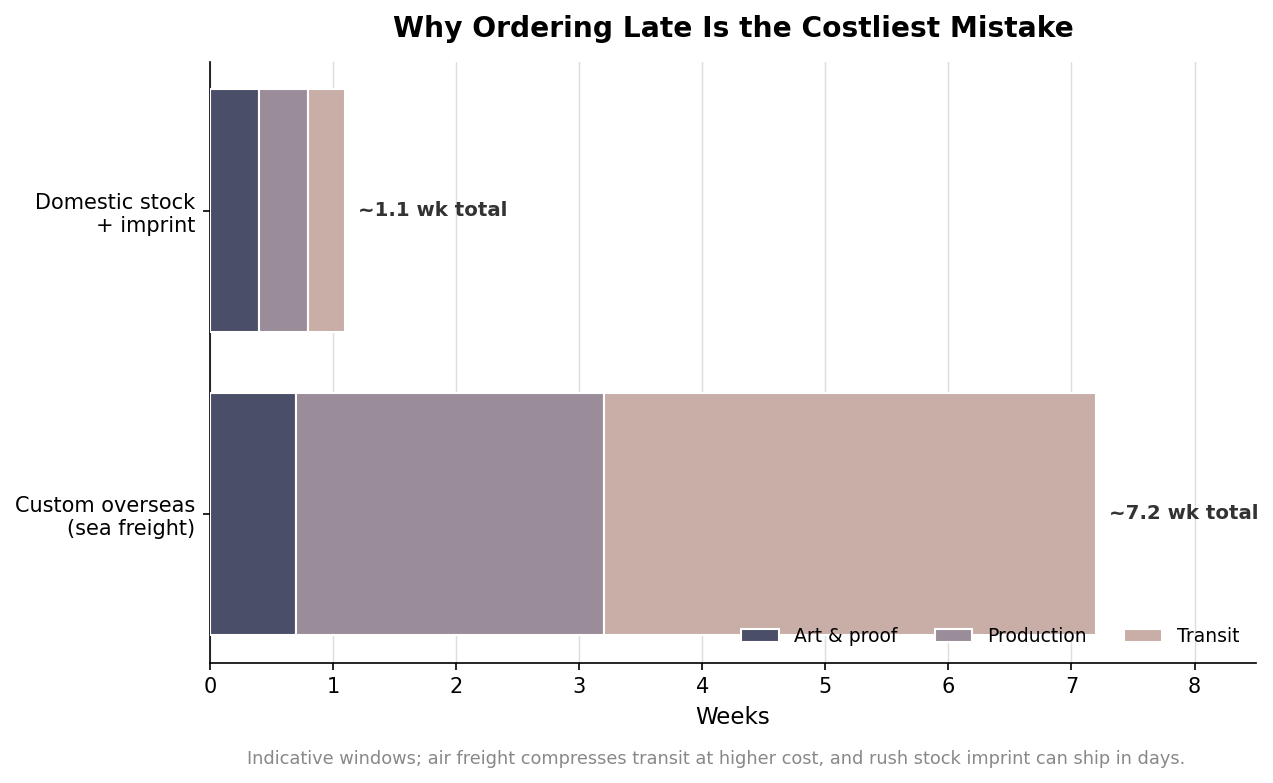
A domestic stock poncho with a simple imprint can turn around in days, which is why it is the right fallback when a date sneaks up. A fully custom overseas run stacks art approval, production, and ocean transit into something closer to a couple of months, and air freight only buys back part of that at a real premium. The practical rule is to lock artwork and quantities weeks earlier than feels necessary, and if the calendar is already tight, choose a faster sourcing route on purpose rather than discovering the constraint after you have committed to a design that cannot arrive in time.
Speccing a thickness that fights the use case
Poncho film is sold by thickness, and thickness is a trade-off, not a quality score. A thin disposable film is light, packs tiny, and is perfect for a one-time giveaway where nobody expects to reuse it. A thicker, heavier gauge survives repeated folding and a full day of wind, which is what you want for a season-ticket crowd or a multi-day festival. Ordering a heavy reusable poncho for a single-use handout wastes money on gauge nobody will use again; ordering the thinnest film for a marching band that needs it every Friday guarantees tears and complaints. Decide first whether this is a use-once or use-again product, then let that choose the gauge, rather than defaulting to whatever quote came in cheapest per piece.
Designing a print the crowd never sees
A poncho worn in the rain is a moving billboard, but only if the print is placed and sized to be seen. The two mistakes here are going too small and putting the art where the body hides it. A logo that looks fine on a flat proof can disappear once the poncho is on a person, gathered at the shoulders and draped over a backpack. Put the primary mark large and high on the back where cameras catch it from behind in a crowd, keep color counts realistic for the print method you chose, and remember that a simple bold design reads from across a stadium while a detailed one turns to mush. If a sponsor is paying for the placement, that is the placement to protect.
Forgetting the pouch, the sizing, and the kids
The last cluster of mistakes is the small stuff that shapes the experience. If your team has to hand ponchos out fast or people need to carry them until the clouds open, a packable pouch is not a luxury; a flat-folded poncho that cannot be re-stowed gets dropped and littered. One-size adult ponchos drown children, so an event with families should carry a youth size rather than pretending one cut fits everyone. And a poncho that will not re-fold neatly becomes ground litter the moment the rain stops, which is a cleanup bill and a bad look. None of these show up on a spec sheet, so they are exactly the details that get skipped, and exactly the ones a crowd remembers.
Order like it is going to rain
Every mistake on this list comes from optimism: assuming light rain, assuming there is time, assuming one size and one gauge and one print will do. Flip each assumption to its pessimistic case and the order gets simple. Buy for the downpour, order earlier than feels necessary, match gauge to reuse, put the print where a camera finds it, and cover the pouch and the kids. Do that and the ponchos become the part of the day nobody has to think about, which is exactly what a good giveaway is supposed to be.
Leave a Reply