Category: Uncategorized

  • Custom Rain Poncho Mistakes That Cost You at the Gate

    Custom Rain Poncho Mistakes That Cost You at the Gate

    Rain ponchos are a low-drama purchase right up until they are not. Get the order right and they are the cheapest goodwill a venue ever buys, keeping a crowd dry and putting a logo on every phone camera in the stands. Get it wrong and you find out at the worst possible moment, with a line at the merch table and a sky that will not quit. The failures are predictable, and every one of them is avoidable at the ordering stage. Here are the mistakes that actually cost event teams money, and how to design them out before you place the order.

    Under-ordering because you planned for drizzle

    The single most expensive mistake is buying for the weather you hope for instead of the weather that empties your table. When it sprinkles, a modest share of a crowd bothers with a poncho. When it genuinely pours and there is no cover, that share climbs steeply, and the two scenarios call for very different quantities.
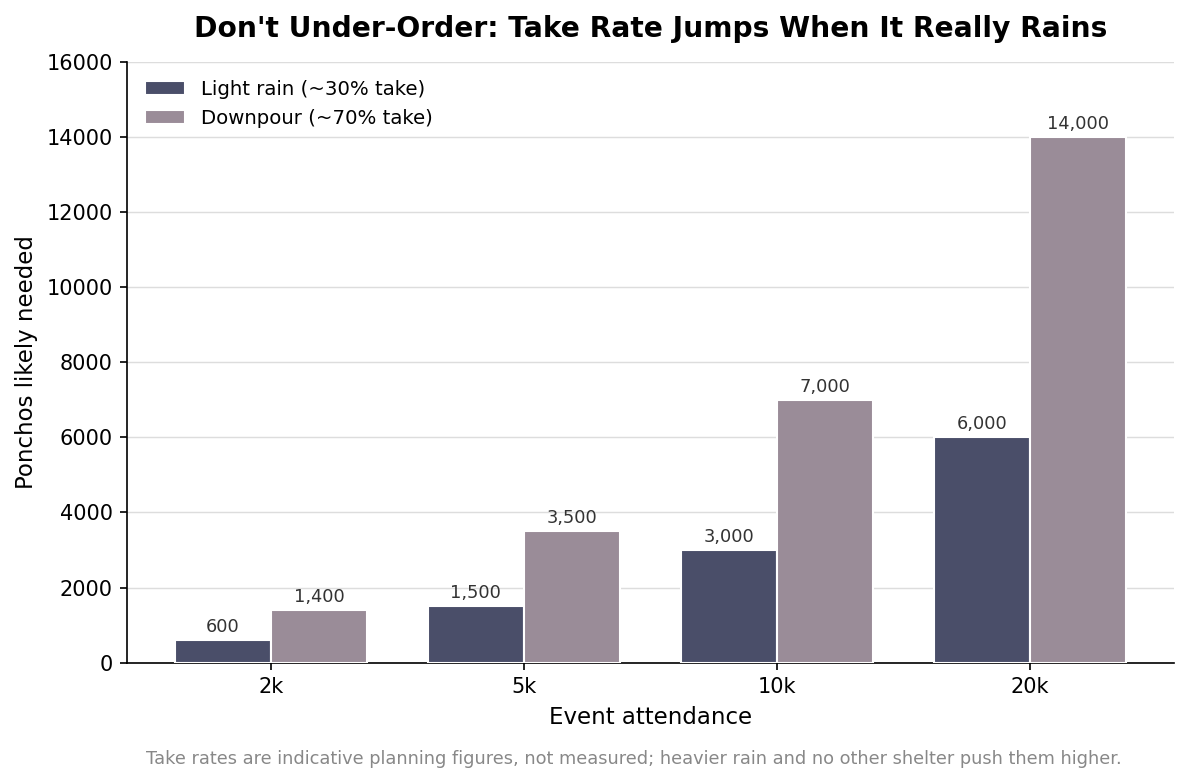
    Grouped bar chart comparing ponchos needed at 30 percent light-rain take versus 70 percent downpour take across crowds of 2,000 to 20,000
    Poncho demand roughly doubles between a light-rain and a downpour crowd at the same attendance.

    The take rates in the chart are planning figures rather than measured facts, but the shape is the lesson: the gap between a light-rain and a heavy-rain crowd is enormous at scale, and stadiums and festivals sit at the right end of that axis. Because unbranded or lightly branded ponchos store flat and keep for years, the cost of over-ordering is a box in a closet, while the cost of under-ordering is a soaked, unhappy crowd and a sponsor whose logo never made it onto anyone’s back. Buy toward the downpour case, not the drizzle case.

    Ordering too late to matter

    The second costly error is treating lead time as a formality. A branded, custom-run poncho manufactured overseas has a very different clock than a stock poncho with a quick imprint, and confusing the two is how orders miss the event entirely.
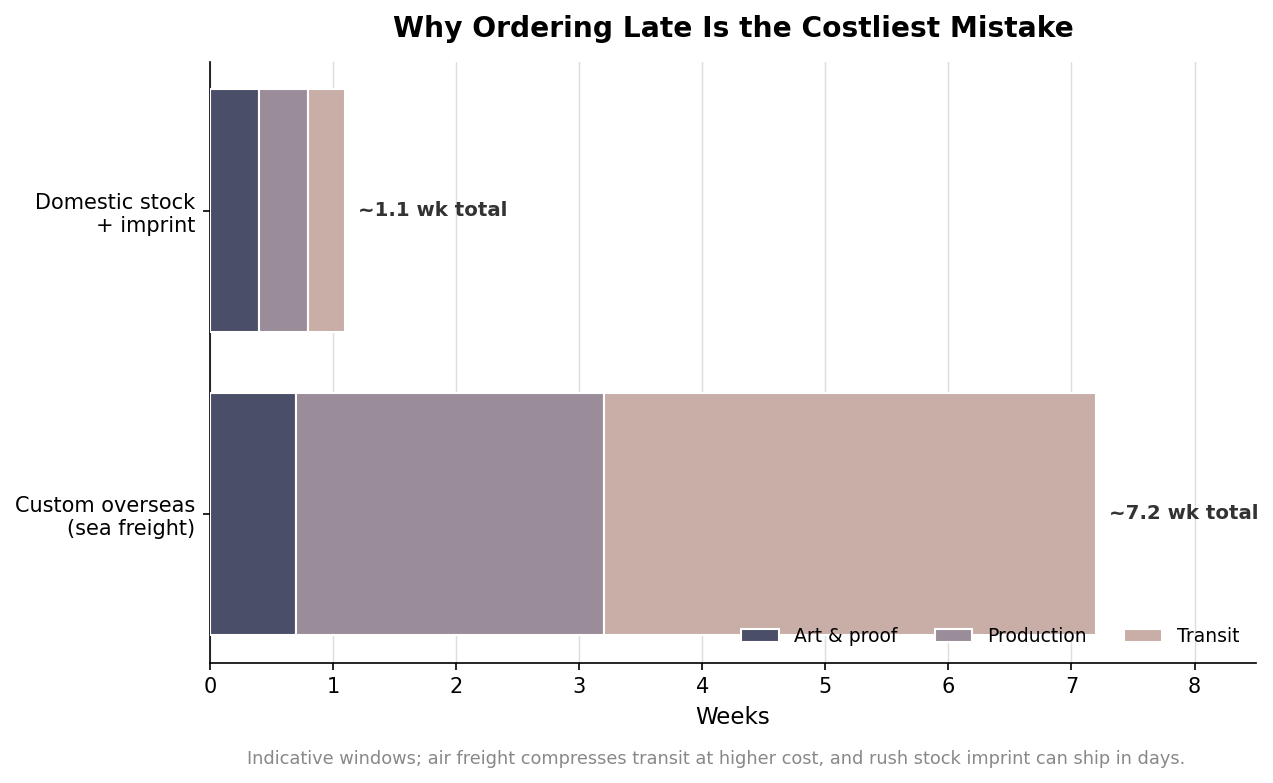
    Stacked horizontal bar comparing lead time for a domestic stock imprint versus a custom overseas order broken into art, production, and transit
    A domestic stock imprint turns in about a week; a custom overseas run runs closer to seven.

    A domestic stock poncho with a simple imprint can turn around in days, which is why it is the right fallback when a date sneaks up. A fully custom overseas run stacks art approval, production, and ocean transit into something closer to a couple of months, and air freight only buys back part of that at a real premium. The practical rule is to lock artwork and quantities weeks earlier than feels necessary, and if the calendar is already tight, choose a faster sourcing route on purpose rather than discovering the constraint after you have committed to a design that cannot arrive in time.

    Speccing a thickness that fights the use case

    Poncho film is sold by thickness, and thickness is a trade-off, not a quality score. A thin disposable film is light, packs tiny, and is perfect for a one-time giveaway where nobody expects to reuse it. A thicker, heavier gauge survives repeated folding and a full day of wind, which is what you want for a season-ticket crowd or a multi-day festival. Ordering a heavy reusable poncho for a single-use handout wastes money on gauge nobody will use again; ordering the thinnest film for a marching band that needs it every Friday guarantees tears and complaints. Decide first whether this is a use-once or use-again product, then let that choose the gauge, rather than defaulting to whatever quote came in cheapest per piece.

    Designing a print the crowd never sees

    A poncho worn in the rain is a moving billboard, but only if the print is placed and sized to be seen. The two mistakes here are going too small and putting the art where the body hides it. A logo that looks fine on a flat proof can disappear once the poncho is on a person, gathered at the shoulders and draped over a backpack. Put the primary mark large and high on the back where cameras catch it from behind in a crowd, keep color counts realistic for the print method you chose, and remember that a simple bold design reads from across a stadium while a detailed one turns to mush. If a sponsor is paying for the placement, that is the placement to protect.

    Forgetting the pouch, the sizing, and the kids

    The last cluster of mistakes is the small stuff that shapes the experience. If your team has to hand ponchos out fast or people need to carry them until the clouds open, a packable pouch is not a luxury; a flat-folded poncho that cannot be re-stowed gets dropped and littered. One-size adult ponchos drown children, so an event with families should carry a youth size rather than pretending one cut fits everyone. And a poncho that will not re-fold neatly becomes ground litter the moment the rain stops, which is a cleanup bill and a bad look. None of these show up on a spec sheet, so they are exactly the details that get skipped, and exactly the ones a crowd remembers.

    Order like it is going to rain

    Every mistake on this list comes from optimism: assuming light rain, assuming there is time, assuming one size and one gauge and one print will do. Flip each assumption to its pessimistic case and the order gets simple. Buy for the downpour, order earlier than feels necessary, match gauge to reuse, put the print where a camera finds it, and cover the pouch and the kids. Do that and the ponchos become the part of the day nobody has to think about, which is exactly what a good giveaway is supposed to be.
  • Rain Poncho Thickness Explained: Mil, Microns, and What Actually Keeps People Dry

    Rain Poncho Thickness Explained: Mil, Microns, and What Actually Keeps People Dry

    Two rain ponchos can be made of the same plastic and perform completely differently, because the number that decides how a poncho feels, folds, and holds up is not the material name printed on the bag. It is the thickness of the film. Buyers get quoted that thickness in whatever unit a given supplier prefers, which is why a spec that reads 0.03 millimeters, 30 microns, 1.2 mil, and 120 gauge can describe the exact same sheet. This is a walk through what those numbers mean, where each type of poncho actually lands, and how to read a thickness spec so you order the right one.

    One measurement, four units

    Film thickness is a single physical dimension expressed four common ways, and knowing the conversions keeps you from comparing two quotes that look different but are not. One mil equals 0.0254 millimeters, which is 25.4 microns. In the plastics trade, gauge is defined so that 100 gauge equals 1 mil. So a 0.03 mm poncho is 30 microns, roughly 1.2 mil, or about 120 gauge, all describing the same wall of plastic between the wearer and the weather.

    The reason this matters for an order is that thickness, not material, is the first-order driver of durability, weight, and cost per unit. Material chemistry changes how the film feels and how it handles cold, but a thicker sheet of the same polymer is stronger and heavier than a thin one. Ask for the thickness figure in writing on any quote, and convert everything to one unit before you compare.

    Where disposable PE ponchos land

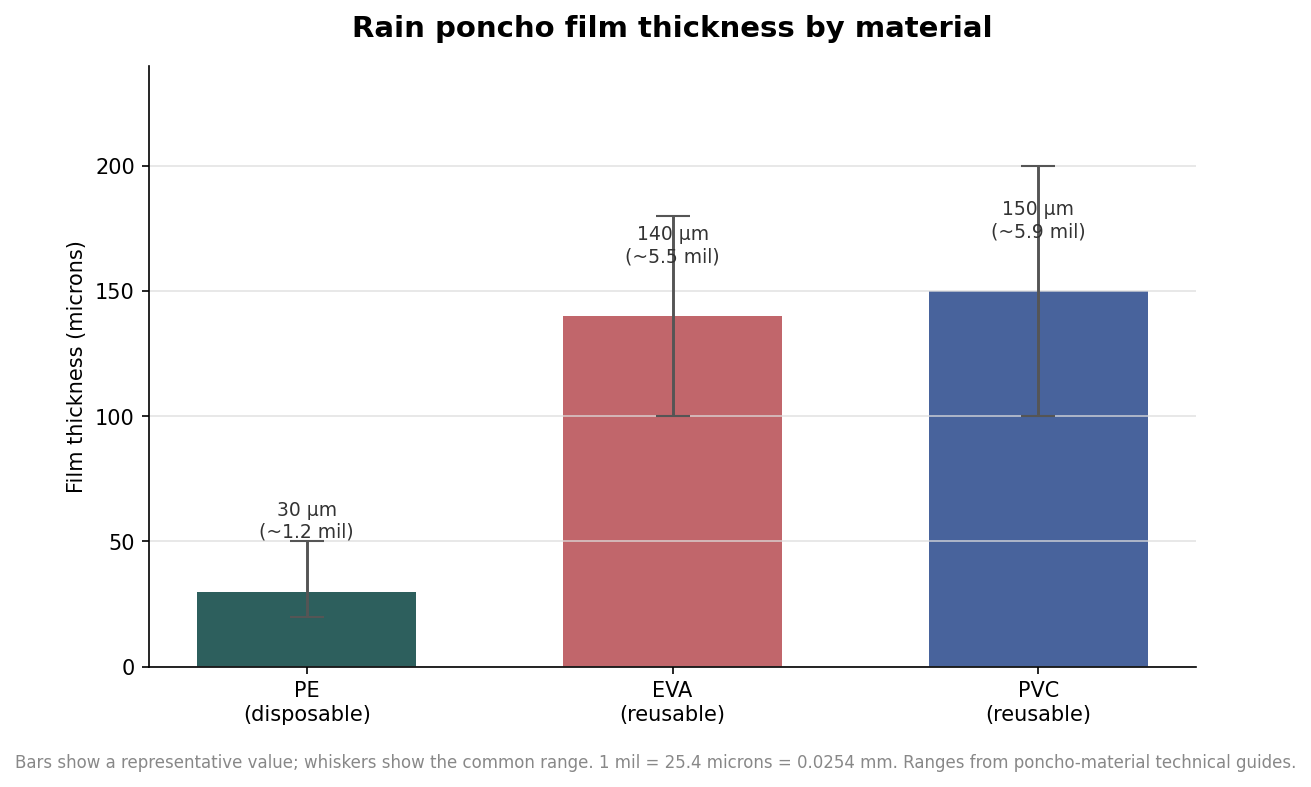
    The lightweight ponchos handed out at stadiums, theme parks, and outdoor events are almost always polyethylene, or PE, in the range of 0.02 to 0.05 mm, which is roughly 20 to 50 microns or about 0.8 to 2 mil. Around 0.03 mm is the common standard for a single-use event poncho: thin enough to fold into a pocket-sized packet and cheap enough to give away by the thousand, thick enough to shed a normal rain shower for the length of a game or a parade. At the very bottom of that band, the emergency ponchos sold for a dollar can be down near 0.02 mm, which is genuinely one-and-done and tears easily once wet and stretched.

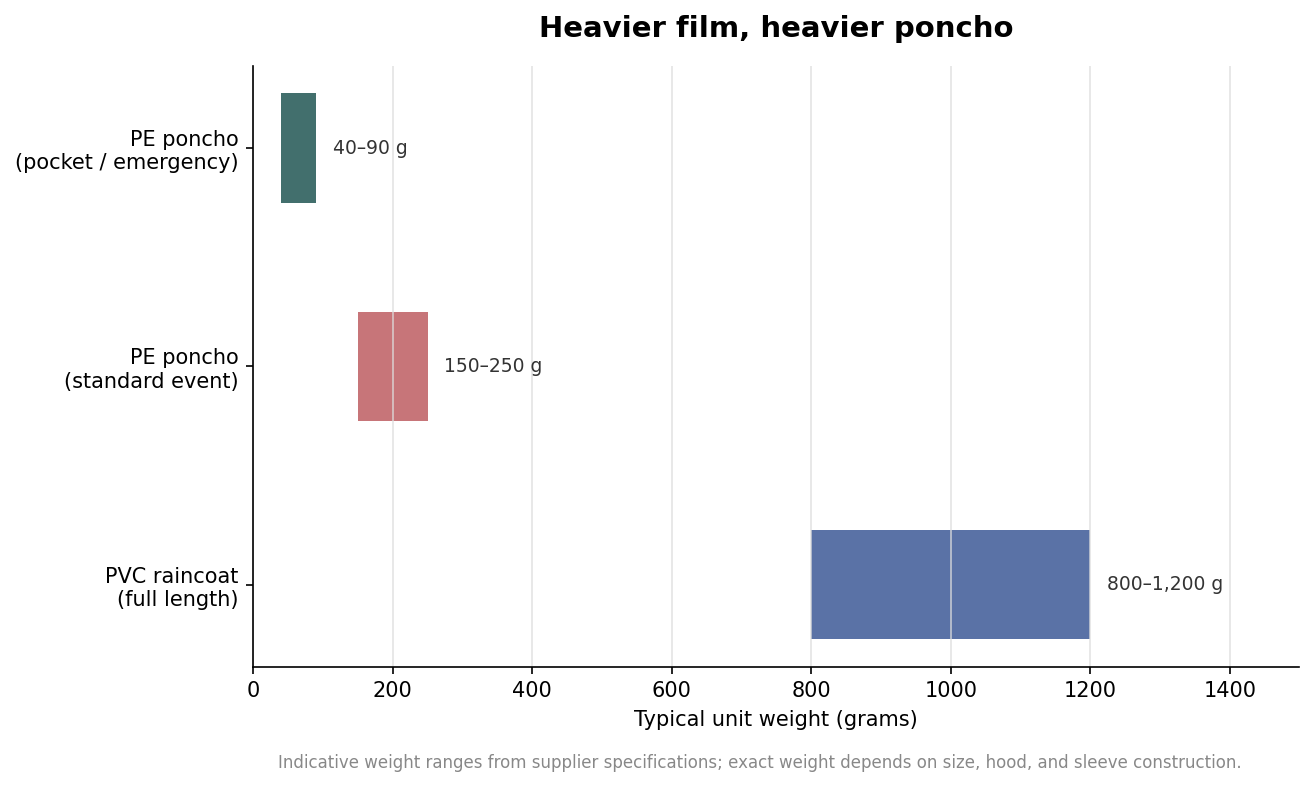
    A standard adult PE poncho is cut around 50 by 80 inches unfolded as a one-size-fits-most piece, and a pocket version weighs well under 100 grams. Heavier PE event ponchos with a proper hood and sleeves push toward 150 to 250 grams. None of this thickness is about being waterproof in the pass-or-fail sense; even the thinnest film blocks water. It is about how many times the poncho survives being put on, sat in, and stuffed back into a bag.

    Bar chart of rain poncho film thickness in microns for disposable PE, reusable EVA, and reusable PVC, with mil equivalents
    Disposable PE film is a fraction of the thickness of reusable EVA and PVC; whiskers show the common range.

    What the extra thickness buys

    Step up to a reusable poncho and the film roughly triples or more. EVA runs about 0.10 to 0.18 mm and flexible PVC about 0.10 to 0.20 mm, in the neighborhood of 4 to 8 mil. That thickness is what makes a poncho feel like a garment rather than a bag: it drapes, it resists tearing at the neck and seams, and it survives repeated folding. Technical comparisons put the tensile strength of heavier PVC film at roughly three to four times that of thin PE, which is why a PVC rain layer can be rated for years of regular use rather than a single afternoon. EVA occupies a middle ground, softer and more pliable than PVC and often chosen when a reusable poncho still needs to pack down reasonably small.

    The cost of that durability is weight and bulk. A full-length PVC rain layer can run from about 800 to 1,200 grams, an order of magnitude heavier than a pocket PE poncho, so it stops being something you hand out at a gate and becomes something a person buys and keeps. Thicker film also raises the per-unit price and the shipping weight of a bulk order, both of which matter when the quantity runs into the thousands.

    Horizontal bar chart of typical rain poncho unit weight ranges in grams from pocket PE to full-length PVC
    Heavier film means a heavier unit, which changes shipping cost and whether a poncho is a giveaway or a keeper.

    Matching thickness to the job

    Work backward from how the poncho gets used. For a one-time giveaway where the goal is that every attendee stays dry enough to enjoy the event and nobody expects to keep the poncho, a PE film around 0.03 mm is the honest match: any thicker and you are paying for durability that gets thrown away. For a gift or resale item that carries a logo people are meant to reuse, the 0.10 mm-and-up EVA or PVC range is where the product feels worth keeping and the branding gets seen more than once. Multi-day events sit in between, and a mid-weight PE or a light EVA often makes more sense than the cheapest film, because a poncho that splits on day one is a poncho that gets littered and reflects on whoever handed it out.

    Thickness also interacts with printing. Thin PE takes a printed logo well but has less surface stability, so large solid ink coverage can look better on a slightly heavier film. If a bold, full-coverage design is central to the order, it is worth confirming with the printer that the chosen thickness supports it cleanly rather than assuming the thinnest option will. Whatever you choose, treat the thickness figure as the spec that anchors the decision: settle the number first, convert every quote to the same unit, and let material and features follow from there.

  • A Venue’s Guide to Rain Poncho Concession Margins — Customized Rain Ponchos

    Call or Text us: (929) 605-4397

    Home › Blog › A Venue's Guide to Rain Poncho Concession Margins

    Economics

    A Venue's Guide to Rain Poncho Concession Margins

    06/30/2026

    When rain hits a stadium, festival, or theme park mid-event, a poncho stops being a nice-to-have and becomes the only thing standing between a guest and leaving early. That shift in demand is predictable, which makes rain ponchos one of the more reliable concession margin opportunities in outdoor venue operations — if they are priced and stocked correctly ahead of time.

    Here is how venues typically think about the math.

    The baseline cost

    A custom full-color printed poncho at bulk quantities typically lands somewhere between $0.60 and $1.75 per unit landed cost, depending on style and volume. That is a small fraction of even a modest concession price point, which is why the category supports strong margins compared to food and beverage items with higher input costs.

    Order sizeTypical per-unit range*
    250$1.30–$1.75
    1,000$0.95–$1.40
    5,000$0.75–$1.10
    10,000+$0.60–$0.90

    *Estimates only, illustrative of typical volume pricing across styles — request a quote for your exact specs.

    Setting a concession price

    Most venues price a branded poncho well above a generic clear one sold at a nearby drugstore, and guests generally accept the premium because the alternative — leaving the venue to find rain gear elsewhere — costs them the rest of the event. Bundling a poncho with a return-entry policy or a discount on a future visit can also lift perceived value without cutting into the margin on the poncho itself.

    Stocking to avoid a stockout

    The worst outcome is running out of ponchos exactly when demand peaks. Venues that track weather forecasts and stock a rain-contingency reserve — separate from everyday concession inventory — avoid both the lost sale and the guest-experience hit of turning people away empty-handed during a downpour.

    Key takeawayA custom rain poncho typically costs well under a dollar per unit at volume, which supports a healthy concession margin as long as you stock ahead of the forecast rather than react to it.

    Planning concession inventory for your venue? Get a custom quote — free mockups in 24–48 hours. Learn more about how we work, or browse more guides.

    More posts

  • How to Order Custom Rain Ponchos for Your Event: A Step-by-Step Checklist — Customized Rain Ponchos

    Call or Text us: (929) 605-4397

    Home › Blog › How to Order Custom Rain Ponchos for Your Event: A Step-by-Step Checklist

    Ordering

    How to Order Custom Rain Ponchos for Your Event: A Step-by-Step Checklist

    05/22/2026

    Ordering custom rain gear for the first time can feel like it requires more decisions than it actually does. Strip away the jargon and it comes down to five things: style, color, artwork, quantity, and timing. Get those five right and the rest of the process runs itself.

    Here is the checklist we walk every new customer through.

    1. Pick a style

    Match the poncho to how it will be worn and for how long. General attendees for a few hours: Standard Drawstring Poncho. Kids at a school or camp event: Kids Rain Poncho. Fast concession or gate distribution: Clear Emergency Poncho. Merch-table or group sales: Festival Pack Poncho. Staff or a full-day outdoor role: Heavy-Duty PE Poncho.

    2. Choose a color

    Clear, Yellow, and Blue are our standard stock colors, and Custom Pantone print is available for brands that need an exact color match. If you are not sure yet, say so on your quote request — we will show you options with your first mockup.

    3. Send your artwork

    Vector files (AI, EPS, SVG, or PDF) print the cleanest, but a high-resolution photo or PNG works too — our designers will recreate it print-ready at no charge if needed. If you do not have a logo yet, tell us what you are picturing and we will build one.

    4. Confirm your quantity

    Our minimum is 250 units for standard, kids, clear emergency, and heavy-duty styles, and 250 packs (2,500 units) for the Festival Pack Poncho. An estimate is fine at the quote stage — we will help you firm it up based on expected attendance or staff headcount.

    5. Lock your timeline

    Standard production is about two weeks from approved mockup. Rush production is available for firm event dates — tell us your in-hands date up front so we can confirm what is possible before you approve the design.

    Key takeawayStyle, color, artwork, quantity, timeline — nail down those five details and a mockup can be in your inbox within 24 to 48 hours.

    Ready to start your order? Get a custom quote — free mockups in 24–48 hours. Learn more about how we work, or browse more guides.

    More posts

  • Drawstring Hood vs. Poncho-in-a-Pouch vs. Heavy-Duty PE: Which Holds Up — Customized Rain Ponchos

    Call or Text us: (929) 605-4397

    Home › Blog › Drawstring Hood vs. Poncho-in-a-Pouch vs. Heavy-Duty PE: Which Holds Up

    Durability

    Drawstring Hood vs. Poncho-in-a-Pouch vs. Heavy-Duty PE: Which Holds Up

    05/05/2026

    Not every rain poncho needs to survive the same conditions. A poncho handed out at a gate and worn for twenty minutes during a passing shower has a very different job than one worn by a groundskeeper or vendor for a full eight-hour shift. Picking the wrong format for the job either wastes money on unneeded durability or leaves your crowd or staff with gear that fails halfway through the day.

    Here is how our three most common formats actually compare under real event conditions.

    Standard drawstring hood

    Our Standard Drawstring Poncho is built from lightweight 0.03mm EVA film with a full drawstring hood and elastic cuffs. It handles a few hours of typical festival or concert wear well — sitting, standing, moving through a crowd — but is not designed for repeated stress like kneeling, crawling under equipment, or extended manual work.

    Poncho-in-a-pouch (Festival Pack)

    Our Festival Pack Poncho uses the same film and construction as the standard style, bundled ten to a resealable pouch. Durability per individual poncho is identical to the standard style — the pouch changes how it is sold and distributed, not how long any single unit lasts once opened and worn.

    Heavy-duty PE

    Our Heavy-Duty PE Poncho uses a thicker 0.08mm PE film with reinforced snap side seams, built specifically for multi-hour wear involving repeated arm movement and contact with rough surfaces — the kind of stress a groundskeeper, vendor, or golfer puts on a poncho over three to five hours.

    FormatTypical wear timeBest for
    Standard Drawstring1–4 hoursGeneral festival & concert attendees
    Festival Pack (10-count)1–4 hours per unitMerch tables, group sales
    Heavy-Duty PE4–8+ hoursStaff, vendors, golfers, field crew
    Key takeawayMatch the poncho to the wear time: standard or pack formats for a few hours of general attendee use, heavy-duty PE for staff and vendors working a full shift.

    Not sure which format your event needs? Get a custom quote — free mockups in 24–48 hours. Learn more about how we work, or browse more guides.

    More posts

  • Rain Ponchos for Golf Courses & Country Clubs: A Buyer’s Guide — Customized Rain Ponchos

    Call or Text us: (929) 605-4397

    Home › Blog › Rain Ponchos for Golf Courses & Country Clubs: A Buyer's Guide

    Golf

    Rain Ponchos for Golf Courses & Country Clubs: A Buyer's Guide

    04/18/2026

    A sudden shower on the back nine ends a round early more often than a course superintendent would like. A branded rain poncho stocked at the pro shop, bag drop, or halfway house is a small investment that keeps members and guests playing through instead of heading for the clubhouse — and it puts the club’s logo in front of every group that reaches for one.

    Here is how clubs typically plan and stock a poncho program.

    Where to stock them

    Most clubs place a small supply at the bag drop for a quick grab before a tee time, a larger reserve at the pro shop for retail sale or member gifting, and a few at the halfway house for guests already mid-round when weather turns. Starter carts and beverage carts are a fourth option for clubs that want full course coverage without relying on a guest walking back to a fixed location.

    Choosing a style

    Our Heavy-Duty PE Poncho is the most common choice for golf because a full round runs three to five hours and the poncho needs to survive repeated arm movement through a swing, sitting in a cart, and brushing against rough or trees. Clubs on a tighter per-unit budget, or those stocking a poncho as a one-time convenience item rather than a keepsake, often choose our Standard Drawstring Poncho instead.

    Branding that fits the setting

    Course logos tend to be more detailed than a festival mark — crests, script wordmarks, founding-year text — and full-color printing reproduces that detail accurately rather than forcing a simplified one-color version. Many clubs print the course crest on the chest and a simple wordmark or website on the back, keeping the design closer to existing merchandise standards than a typical event giveaway.

    Sizing the order

    A reasonable starting point is one poncho per 15 to 20 rounds played during rain-prone months, refreshed seasonally, plus a smaller retail allocation for pro-shop sales if members ask to buy one to keep. Clubs with a member gifting program sometimes order a batch specifically for new-member welcome kits or club championship gift bags.

    Key takeawayStock Heavy-Duty PE Ponchos at the bag drop and halfway house for full-round durability, and use full-color printing to reproduce a detailed course crest accurately.

    Planning a poncho program for your course? Get a custom quote — free mockups in 24–48 hours. Learn more about how we work, or browse more guides.

    More posts

  • EVA vs. PE Film Rain Ponchos: Which Material Should You Order — Customized Rain Ponchos

    Call or Text us: (929) 605-4397

    Home › Blog › EVA vs. PE Film Rain Ponchos: Which Material Should You Order

    Materials

    EVA vs. PE Film Rain Ponchos: Which Material Should You Order

    04/01/2026

    Almost every disposable rain poncho on the market is made from one of two film types: EVA (ethylene-vinyl acetate) or PE (polyethylene). They look similar at a glance, but they behave differently in the field, print differently, and land at different price points — details worth understanding before you commit to a bulk order.

    Here is how the two materials actually compare.

    Feel and flexibility

    EVA film has a softer, slightly rubbery hand-feel and drapes closer to the body, which is why most of our standard and kids ponchos use it — it feels less like wearing a trash bag and more like a purpose-built garment. PE film is stiffer and crinklier, but that same stiffness is what lets it hold up to a thicker gauge without becoming heavy or hot, which is why our Heavy-Duty and Clear Emergency styles use it.

    Printing and clarity

    EVA takes full-color print with a slightly warmer, less glossy finish, which shows logo colors accurately without excess shine under stage or venue lighting. PE film, particularly in a clear, unpigmented form, is more transparent than EVA, which is why our Clear Emergency Poncho specifically uses PE — the higher transparency lets the wearer’s outfit or the venue behind them show through, with the printed logo appearing to float on top.

    PropertyEVA FilmPE Film
    Typical gauge0.03mm–0.05mm0.03mm–0.08mm
    FeelSofter, closer drapeStiffer, crinklier
    ClaritySemi-matte, less transparentHigher clarity when unpigmented
    Best forStandard & kids ponchosClear emergency & heavy-duty ponchos
    Relative costSlightly lower at equal gaugeSlightly higher at heavier gauge

    Durability at different gauges

    Thickness matters more than material type once you get past a certain point — a thin PE film and a thin EVA film perform similarly under stress, while a heavier PE film clearly outperforms both for repeated movement and multi-hour wear, which is why our Heavy-Duty Poncho uses the thickest PE gauge in our line.

    Key takeawayChoose EVA for a softer feel on standard and kids ponchos, and PE for clarity (Clear Emergency Poncho) or maximum durability at a heavier gauge (Heavy-Duty PE Poncho).

    Not sure which material fits your event? Get a custom quote — free mockups in 24–48 hours. Learn more about how we work, or browse more guides.

    More posts

  • Custom Rain Ponchos for Festivals & Concerts: Quantities & Personalization — Customized Rain Ponchos

    Call or Text us: (929) 605-4397

    Home › Blog › Custom Rain Ponchos for Festivals & Concerts: Quantities & Personalization

    Events

    Custom Rain Ponchos for Festivals & Concerts: Quantities & Personalization

    03/15/2026

    Most festival organizers order rain ponchos the same way they order water bottles: grab a round number and hope it covers the day. That approach works fine for utility, but it leaves value on the table when a poncho could just as easily be a piece of merch a fan actually keeps and photographs.

    Here is how to think about quantity and personalization before your next event.

    Sizing your order to actual attendance

    A useful starting rule is to plan for 15 to 25 percent of expected attendance carrying or wearing a poncho at some point during a multi-day festival with any chance of rain, and closer to 40 to 60 percent for a single rain-forecast day where a poncho is the difference between staying and leaving. For a gate giveaway model, order to your full expected attendance for the specific day you are distributing; for a merch-table or concession model, 10 to 15 percent of the day’s attendance is a reasonable starting sell-through estimate, refined by past event data if you have it.

    Personalization that actually gets used

    A poncho with just a logo gets worn and discarded. A poncho with the festival name, the year, and the specific stage or day printed on it gets kept, because it becomes a souvenir of a specific memory rather than a generic piece of plastic. Full-color printing makes this easy — a lineup graphic, a stage map, or a date stamp costs no more to print than a single-color logo would, since our full-color process covers the whole design in one pass.

    Choosing a distribution model

    Gate handouts work best when weather is uncertain and you want every attendee covered without a transaction; our Standard Drawstring Poncho or Clear Emergency Poncho both work well here depending on budget. Merch-table sales work best when you want the poncho to feel like a keepsake rather than a freebie, and our Festival Pack Poncho’s printed header card gives merch tents a shelf-ready product without extra packaging work on your end.

    Key takeawayPlan quantity around your actual distribution model — full attendance for a gate giveaway, 10 to 15 percent for merch-table sales — and use full-color printing to make the poncho feel like a keepsake, not just rain cover.

    Ready to plan your event’s rain ponchos? Get a custom quote — free mockups in 24–48 hours. Learn more about how we work, or browse more guides.

    More posts